Utility Stream and Wodr have been running for eight years, and like most businesses, we’ve seen our fair share of change during that time.
But the last couple of years have felt different.
AI has moved quickly from something businesses were talking about to something that’s starting to influence how work actually gets done — across operations, sales, marketing, customer service, data and everything in between.
For us, there are two fairly obvious mistakes businesses can make here.
Ignoring AI and the ways it could support your teams is one of them. Jumping headfirst into every new tool without understanding the problem you’re trying to solve is the other.
So, we decided to start with the problems.
Before The Tech, Understand The Process.
We’ve formed a development team to look at where AI, automation and better use of technology could realistically improve the way we work.
The first stage wasn’t about choosing platforms, building tools or deciding where AI should be used. It was discovery.
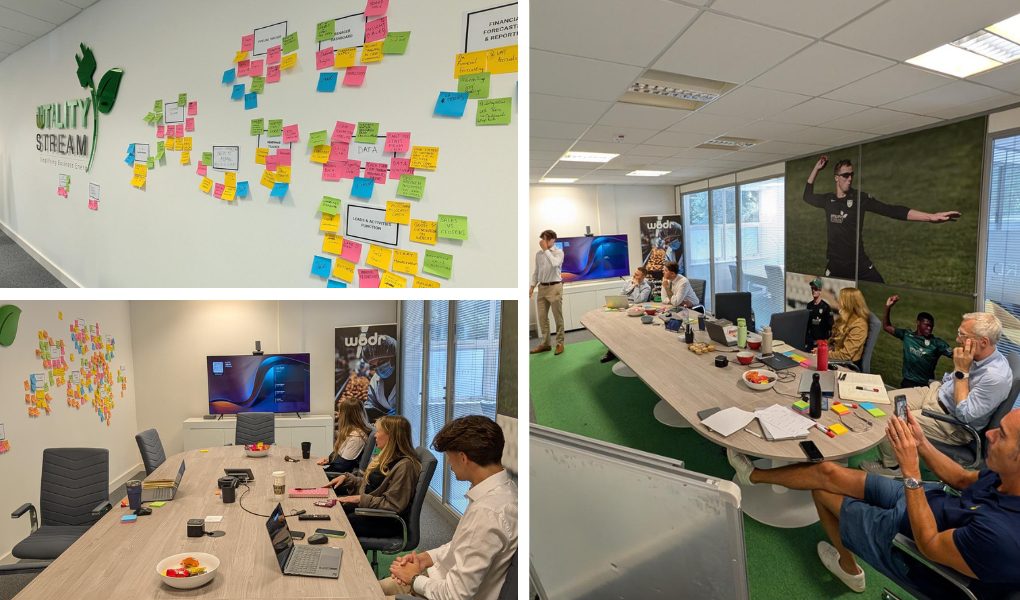
We ran workshops across our teams, from directors through to apprentices, to understand how people actually work day-to-day and where the friction sits.
Where are we spending time on repetitive tasks? Where does information get stuck between teams? What processes involve unnecessary manual input? Where could better access to data help someone make a faster or more informed decision?
And, more specifically for an energy consultancy, where could technology help with things like customer communication, contract and consumption data, renewals, supplier information, sales processes and ongoing account management?
Nothing particularly flashy. Just looking properly at the processes we use every day.
Lots Of Post-its. Lots Of Useful Conversations.
Unsurprisingly, once we started mapping things out, our workshop ‘Post-it wall’ filled up pretty quickly.
The workshops gave us a much clearer picture of the challenges different teams experience and, importantly, where those challenges overlap.
That matters.
A small inefficiency in one team can create additional admin somewhere else. A gap in data capture can affect what happens further down a process. Something that looks like a sales problem might actually start with how information is collected or shared much earlier.
Looking at those connections before deciding on a technical solution has been a big part of the discovery process.
And stage one of that discovery is now complete.
Now Comes The Planning.
We’re moving into the planning stage, which is deliberately not a quick process.
We’ve got plenty of ideas, but the next job is working out which ones are technically feasible, which will help us support our clients the most and which could have the biggest impact on our team.
That means looking at existing systems and integrations, data quality, security, workflows, resource requirements and, ultimately, whether AI is actually the right solution.
Because sometimes it will be.
Sometimes automation will make more sense.
Sometimes the answer might just be fixing an existing process.
The interesting part for us isn’t simply using AI. It’s understanding where these technologies can support our team and help us deliver a more efficient service for customers.
AI is changing the way businesses work, and that change isn’t slowing down.
We don’t think the answer is to chase it.
But we don’t think it’s something to shy away from either.
For now, discovery is done. Planning is underway. And we’re looking forward to seeing where it takes us.
What’s Next In The AI x USL Universe?
We’re a forward-thinking business, always looking at how we can improve the way we work and, ultimately, deliver the best possible experience for our customers. There’s plenty still to explore, test and develop, so stay tuned as we work through the next phase and bring some exciting new developments to Utility Stream.